Texas International Airlines Flight 655

The Final Flight
Texas International Airlines Flight 655 was a Convair 600, registered N94230, flying from Memphis, Tennessee, to Dallas, Texas, with scheduled stops in Pine Bluff, El Dorado, and Texarkana. On the night of September 27th, 1973, the aircraft struck Black Fork Mountain near Mena, Arkansas, killing all eight passengers and three crew members. The photograph shows N94230 just three months before that fateful night.
Before departing El Dorado, the crew spoke with the tower about a line of thunderstorms approximately 35 nautical miles to the west. They took off under Visual Flight Rules (VFR), with the first officer flying and the captain navigating around the weather. No further radio transmissions were received from the aircraft after takeoff.
As the flight continued, the first officer became increasingly concerned about their position and the height of the surrounding terrain. About three minutes before impact, the captain told him that the highest ground in the area was 1,200 feet. After consulting his charts, the first officer began to read out that there was a minimum en route altitude of 4,400 feet. His final words were cut short as the aircraft struck the steep, wooded northern slope of Black Fork Mountain.
The impact occurred at approximately 2,025 feet above sea level, about 600 feet below the ridgeline.

The Search
A search began when Flight 655 failed to arrive in Texarkana. Initial efforts along its expected route found no sign of the aircraft. An air traffic controller at Fort Worth Center had observed an unidentified VFR target leaving El Dorado and heading northwest. That information helped searchers locate the wreckage at approximately 5:30 p.m. on September 30th, almost three days after the crash. The newspaper headline shown here appeared in The Shreveport Times on October 1st, 1973.
The Arkansas Civil Air Patrol and the 43rd Aerospace Rescue and Recovery Squadron took part in the search. In all, 224 aircraft flew 478 sorties, logging 1,235.4 hours. The search also claimed three more lives when an Arkansas Army National Guard helicopter crashed.
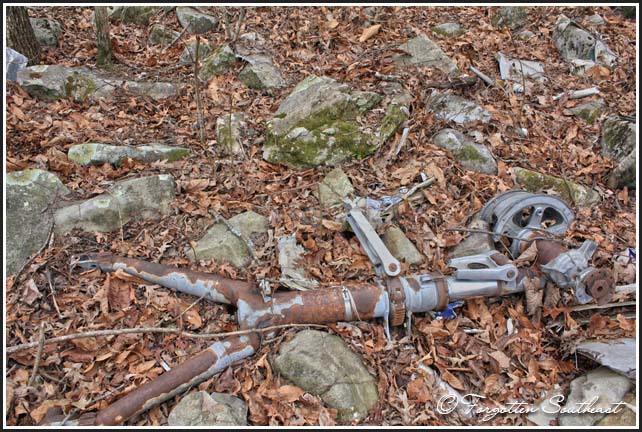
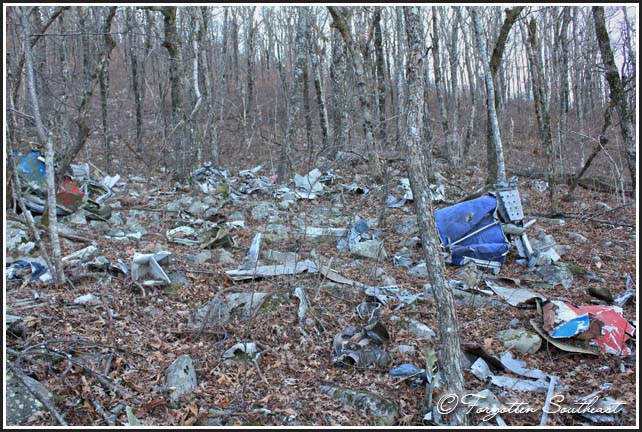
Once the wreckage was found, pararescuemen were lowered to the site to recover the victims and flight recorders. The remote location and steep terrain made recovery difficult. The photographs in the gallery below show wreckage that remained on the mountainside at the time of my visit.
The Investigation
The National Transportation Safety Board (NTSB) determined that the captain had attempted to continue under visual flight rules in nighttime weather conditions that required instrument flying. The investigation also found that he had departed from the planned route without adequate position information and had failed to use the navigation aids and information available to him.
The NTSB also identified shortcomings in the airline's monitoring and control of the flight. Its findings described a flight that had strayed far from its intended course while the crew remained uncertain of their position over mountainous terrain.
This flight helped pave the way for new FAA regulations. Because the crew flew under VFR, they were not required to discuss their intended route. Had they been operating under Instrument Flight Rules (IFR), they would have been tracked by radar and required to make position reports. The FAA now requires all commercial flights to operate under IFR.
The NTSB report may be downloaded and read here.
Flight 655 Passengers and Crew
The following crew members and passengers lost their lives in the crash.
Crew:
Captain Robert McDonald Crosman, 41, Irving, Texas.
First Officer William Fred Tumlinson, 37,
Dallas, Texas.
Flight Attendant Marilla Jeana Lotzer, 23, Dallas, Texas.
Passengers:
Army Col. Clayton Craft, 49, Texarkana, Texas.
Army Col. Robert B. Hoppe, 47, Texarkana,
Texas.
Army Col. Arthur B. Glenn, 46, Texarkana, Texas.
Marion Royce Evans, 39, Hooks, Texas.
Milton
C. Johnson, 51, Texarkana, Texas.
John Thomas Torrence, 49, Texarkana, Texas.
John Hawkins, Jr., 18,
Texarkana, Texas.
Mrs. Bonnie McCullough, 65, LaGrange, Georgia.
Arkansas Army National Guard Crew
Three Arkansas Army National Guard crew members also lost their lives when their helicopter crashed near Prescott, Arkansas, while searching for Flight 655. The crew members were:
Captain John Larry Bearden, pilot.
Captain William Robert West, co-pilot.
Specialist 6 David Murle Webb, crew chief.